The instinct when engagement drops: post more.
More prompts. More resources. More value. Surely if we just keep showing up, they will too. It's the community manager equivalent of talking louder when someone doesn't understand you. Maybe if I just SAY MORE THINGS, this will work.
Six years of running a community solo taught me something uncomfortable: more content often accelerates disengagement. Not because the content is bad. But it compounds the wrong problem.
You're not failing at content. You're succeeding at making noise.
The Real Issue

Bigstock
Content without pathways becomes noise. And nobody joins a community thinking, "You know what I need? More noise."
Your members don't lack information. They lack clarity on what to do next. They're watching. Reading. Consuming. But here's the thing: consumption isn't participation. And watching isn't momentum. Watching is what people do when they don't know what else to do.
We track views, completions, and time spent. We celebrate when people "show up." But showing up isn't the same as taking action. If it were, I'd be a marathon runner by now based on how many running videos I've watched.
The question isn't "what should we post?" It's "what should this content make possible?"
If your answer is "inform them" or "inspire them"—cool. But informed and inspired people who don't do anything are just...well-read lurkers.
The Shift: From Content Volume to Designed Participation

Bigstock
Most community advice assumes you need more. More posts. More events. More touchpoints. The logic feels airtight: if engagement is low, we must not be giving them enough.
But what if the opposite is true?
What if members are drowning in content and starving for direction?
It's like being in a restaurant with a 47-page menu. You don't feel abundance. You feel paralyzed. And then you order chicken fingers because at least you know what those are.
Momentum doesn't come from consistent showing up. It comes from designed action. Every piece of content should have a job—not just a slot on the calendar.
In our community, I've tested a rhythm: three posts a week. One focused on read and act. One on refine. One on reflect and share. It's not about the topics. It's about the participation modes. Each post invites a different kind of engagement.
That distinction matters. It's not "here's more information." It's "here's what to do with it."
Revolutionary concept, I know.
The Threshold Problem
 Bigstock
Here's the real challenge: how do you move someone from consumer to participant?
People buy courses and never open them. Join communities and never post. Access everything and do nothing. Then—and this is my favorite part—they get mad at themselves. Or at you. "This didn't work." No, you had access to something and treated it like a Netflix queue you'll "get to eventually."
But the problem isn't motivation. Motivation is a scapegoat.
The problem is the threshold.
The members who become your most engaged participants aren't necessarily more motivated than everyone else. They crossed a threshold. Something clicked. They stopped consuming and started acting.
And in a diverse community—where your members span industries, roles, experience levels, and contexts—you can't design one path that works for everyone. There's no single hero's journey. No linear progression that magically works for the nurse in Ohio, the laid-off tech worker in Austin, AND the mid-career finance professional in Toronto.
So what do you design for instead?
Designing for the Puzzle, Not the Path

Bigstock
Think of your community like a puzzle.
Everyone starts with the same borders—your foundational knowledge, your core frameworks, the basics that orient them to your world. The edges. The structure.
But the interior? That gets assembled in whatever order makes sense for each person. And if you've ever watched someone do a puzzle differently than you would, you know this can be deeply unsettling. But it works for them.
You even have to design for the crazies who start with the interior and work out to the edges. Disturbing. But they exist. And they're members too.
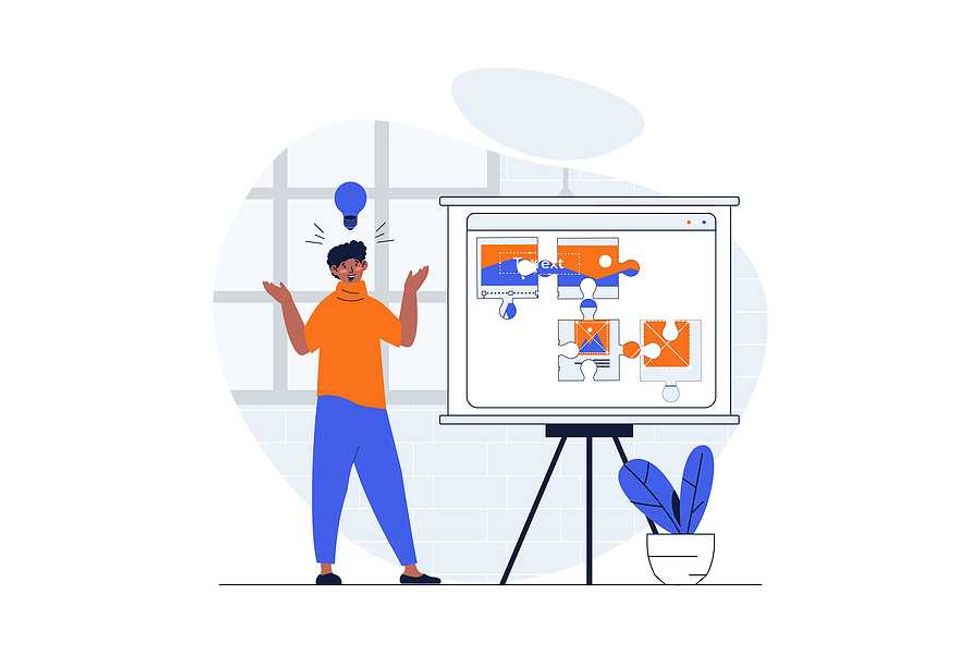
Events, courses, coaching moments, community conversations—these are all puzzle pieces. The "aha" isn't a single moment. It's what happens when enough pieces connect that the picture suddenly makes sense.
Here's the thing: you can't control the order. You can't hand someone their next piece and expect enlightenment. Dumping more puzzle pieces on the table doesn't make the picture form faster. That just creates the kind of overwhelm where someone closes the laptop and watches TV instead.
Your job isn't to design the sequence. Your job is to design the conditions.
What Changes When You Think This Way
 Bigstock
When you stop optimizing for content volume and start designing for participation thresholds, a few things shift:
You audit differently. Instead of asking "Is this good content?" you ask "Does this create a pathway or a dead end?" Every piece either moves someone toward action or leaves them stranded with information they can't use. Stranded people don't become engaged members. They become people who "meant to get back to that."
You design for the next step, not just the takeaway. The insight isn't the point. What they do with it is. Embed the ask inside the value. Make action happen in the same breath as understanding. Don't make them figure out what to do next. They won't.
You reduce friction strategically. Shrink the first action to almost nothing. Remove the "figure it out" tax. Make participation the path of least resistance—not because you're lowering the bar, but because you're clearing the path. There's a difference between making something easy and making something obvious.
You build scaffolding, not more content. Less information, more structure. Less "here's what you need to know" and more "here's how to know what to do next." Your members don't need another PDF. They need a next step.The Transformation You're Actually Designing For
Bigstock
In our professional community, the shift isn't content-specific. It's posture-specific.
Members come in reactive. They're job seekers—on again, off again, waiting for something to happen to them. They consume because that's what feels productive when you don't know what else to do. It's career-building as doomscrolling.
And the cycle reinforces itself: they land a job, they leave. Something goes wrong, they come back. Reactive in, reactive out. The community becomes a place you visit when things fall apart—not a place that prevents things from falling apart.
It's like only going to the gym after you pull a muscle. Technically using the resource. Not exactly the point.
The transformation happens when they stop reacting and start controlling the narrative. Their strategy. Their mindset. Their next move.
The long game—built through intentional tracks, loops, and systems—should serve members to become proactive and long-term in how they approach their careers. Not just helping them get the next job, but helping them stop needing to scramble for it.
That "aha" can be triggered by anything—an event, a coaching moment, a peer conversation, a single sentence in a course. You can't engineer the exact moment it clicks. But you can engineer the possibilities. Multiple touchpoints. Varied entry points. Different modes of engagement. The more contact points you design, the more likely members find the one that makes it click for them—in whatever order that happens.
You do that by designing for behavior change, not content completion.
In diverse communities, you can't assume shared context. But you can design for shared transformation. The nurse and the tech worker and the finance professional don't need the same content. But they need the same shift: from waiting to acting.
The Uncomfortable Truth

Bigstock
More content feels productive. It's measurable. It's something you can point to when someone asks what you've been doing.
"I posted 47 times this month."
Great. Did anyone do anything?
More content can also be a way to avoid the harder question: why aren't the people who already have access taking action?
The answer is rarely "they need more information." It's usually "they need clearer pathways."
Less content, more scaffolding. Less volume, more design. Less showing up and more showing the way.
A question to sit with:
Look at your last five pieces of content. For each one, can you name the specific action it was designed to make possible?
If the answer is "consume this" or "learn this" or "be inspired by this"—you might have a content calendar.
But you don't have a participation strategy.
And honestly? That's most of us at some point. The question is whether you keep posting louder or start designing smarter.
- Community Onboarding Strategy: What Years of Iteration Actually Taught Me ›
- Why Communities Lose Momentum (Even When Engagement Is High) ›
- Building A Strong Community For Career Success: A Path To Elevate Your Trajectory ›
- Is Your Community a Container or Infrastructure? - Work It Daily ›

 Bigstock
 Bigstock
 Bigstock